
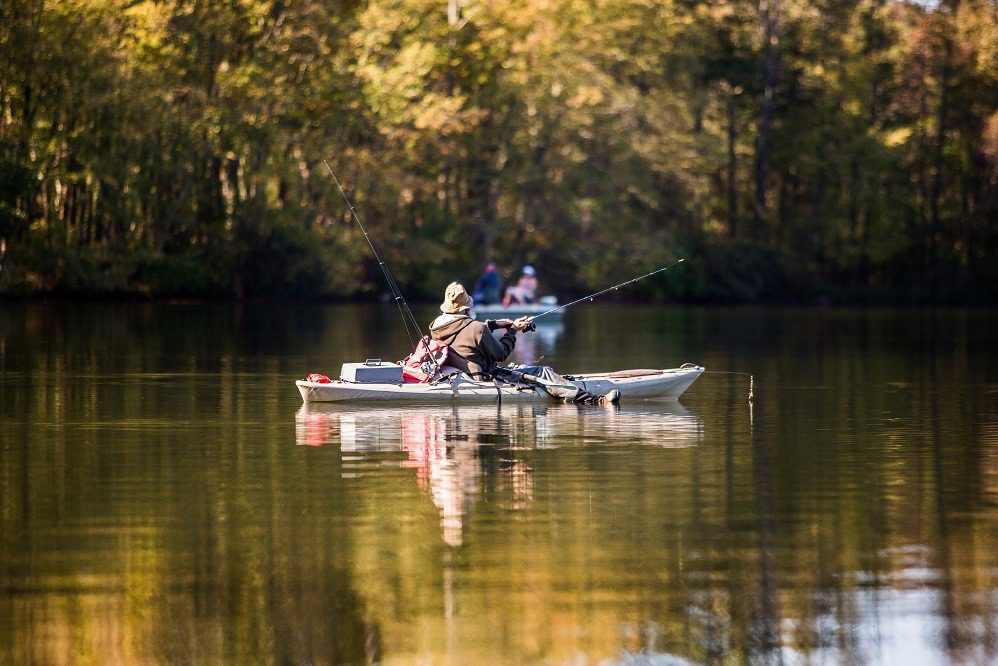
To outfit a kayak for fishing, start with safety gear (a life jacket, a whistle and a white light), then add rod holders, a paddle leash and, if you fish in still water, an anchor you can release in seconds. Comfort and electronics come last.
WaterSportHQ editors have not rigged a kayak for this page. The facts below come from the sources named next to them. Tips with no source are marked “Editors’ rule of thumb”. If you do not own a fishing kayak yet, see the best kayak for fishing comparison and sit-on vs sit-in kayaks for fishing first.
Start with required safety gear
The Florida Fish and Wildlife Conservation Commission lists what human-powered vessels, kayaks included, must carry (FWC, human-powered vessels):
- “One U.S. Coast Guard-approved wearable life jacket for each person on board.”
- “A bell, horn or whistle that can be heard for a least one-half nautical mile.”
- “One lantern or flashlight shining a white light if operating between sunset and sunrise or when visibility is restricted.”
That is Florida’s page. Other states set their own rules, so check your state wildlife or boating agency. Editors’ rule of thumb: wear the life jacket instead of stowing it, and clip the whistle to it.
Rod holders
Florida Sportsman says flush mount holders “come standard on many fishing kayaks”, usually behind the seat. It adds that many newer kayaks have track systems “that allow you to install rod holders almost anywhere”, and that “a milk crate with PVC rod holders may be all you need” if you are not trolling (Florida Sportsman, rod holder styles).
How many? Florida Sportsman says “One or two rods, with three being the max.” Older versions of this page said you need at least three. Sources differ, so match the number to how you fish.
If you drill your own mounts, the same article says to pick a spot that “won’t interfere with paddling” and to use stainless steel hardware made for the job. It warns that “Stainless steel screws screwed into the plastic will weaken with use.” Editors’ rule of thumb: tie each rod to the kayak with a leash so a dropped rod does not sink.
Paddle leash
Editors’ rule of thumb: a paddle you cannot reach is a paddle you have lost, so tether it to the deck. A coiled or bungee leash on a deck fitting is common. Fit the leash so it cannot wrap your legs if you tip.
Anchor, and how to release it
Two guides agree on the main risk. Kayak Fishing Blog says “You are at most danger of capsizing when the kayak is side-on at anchor”, that current makes this worse, and that the trolley should sit at the bow or stern, not mid-ship (Kayak Fishing Blog, anchoring guide). Wild Paddler says to “always anchor from the bow (front) so your kayak faces upstream” in rivers, to stay “away from strong currents”, and to be ready to unclip or cut the rope if the anchor cannot be freed (Wild Paddler, how to anchor a kayak).
On anchor type and weight, the two guides give different figures:
- Wild Paddler lists 1.5 to 3 pounds for a grapnel anchor and 3 to 5 pounds for a mushroom anchor. The older version of this page said “not more than three pounds”.
- Kayak Fishing Blog says an 8 pound (3.6 kg) mushroom anchor “works well for kayaks” in soft mud, and calls a folding grapnel “great for most grounds”. It says Bruce (claw) anchors are for soft sediments such as sand, mud and gravel.
Editors’ rule of thumb: do not anchor in current or surf, and carry a knife where you can reach it with either hand.
Comfort, gear and electronics
These are Editors’ rule of thumb tips. No source was checked for them.
- Seat: pick one with padding and back support, since you sit still for hours.
- Organization: keep what you need most within reach and tie down loose gear.
- Gear tracks: they let you add and move accessories without drilling again. Florida Sportsman notes many newer kayaks already include them.
- Fish finder: a transducer mount and a battery take space. Check the listing for a fish finder mount before you buy, as the fishing kayak comparison does.
- Deck padding: it can quiet a dropped lure or tool. No source says how much it matters.
- Flag: a flag makes a low kayak easier for other boats to see. A white light is the required item (see above).
Before you buy
- Fit: see what size kayak do I need.
- Paddle: see kayak paddles.
- Boat: see the best kayak for fishing.